No Tirthankara begins as a Tirthankara, and no religious founder’s story begins like this one. Every other great teacher appears inside an existing civilization. In the Jain telling, Rishabhanatha appears at the moment civilization itself becomes necessary, and he builds it: fire, farming, writing, law, marriage, and only then, the path out of all of it.
His Life at a Glance
The soul descends from Sarvarthasiddhi heaven into Queen Marudevi's womb; she sees the fourteen great dreams (sixteen in the Digambara counting), the first of them a white bull.
The 56 Dikkumaris perform the birth rites; the Indras bathe the infant on Mount Meru from 1,008 pitchers.
Fire, crafts, agriculture, writing, law and marriage are taught; he rules 63 lakh purva from Vinita, the city later called Ayodhya.
After a year of giving away his wealth, he renounces under an ashoka tree with 4,000 companions, plucking his hair in four handfuls.
Prince Shreyansa offers sugarcane juice at Hastinapur: the origin of Akshaya Tritiya and of alms-giving itself.
After 1,000 years of austerity, omniscience arises under a banyan tree at Purimatala. The fourfold sangha is founded.
With 10,000 munis, in the constellation Abhijit. Observed to this day as Meru Trayodashi.
Thirteen Lives Before the First Life
The Shvetambara tradition traces his soul through thirteen births, and the arc is a complete lesson in how liberation is earned. Solid chips below are human lives; dashed chips are the heavens between them.
It begins with Dhana, a caravan merchant, whose entire spiritual career starts with one act: offering fresh ghee to a stranded monk during the rains. Hemachandra says that by the power of that single gift “the seed of the tree of moksha” entered him. Lives later he is Jivananda, a physician who, with five friends, cures a disease-ridden monk no one else would touch. Later still he is Vajranabha, a Chakravartin emperor who renounces an empire and binds Tirthankara-nama-karma, the karma of world-teacherhood, through twenty practices of devotion and service.
Notice what the sequence rewards: a merchant’s generosity, a doctor’s service, an emperor’s renunciation. Three careers any reader might hold. (The Digambara Adi Purana counts ten births; the shape of the story is the same.)
And a detail that turns the whole biography into one interlocking machine: the companions of those past lives return as Bharata, Bahubali, Brahmi, Sundari and Shreyansa, the family of his final life. Jain karma theory does not do coincidences.
The Fourteen Dreams, and the Dream That Named Him
When the soul entered her womb, Marudevi saw the sequence of great dreams. For every other Tirthankara’s mother, the first dream is an elephant. For Rishabha alone, the first dream was a white bull, and that, together with the bull mark on the infant’s thigh, gave him his name.
Shvetambara counting, per Hemachandra. The Digambara tradition counts sixteen dreams, adding a pair of fish and a lion-throne, with the Airavata elephant first; and in the Adi Purana it is the clairvoyant grandfather Nabhi himself, not Indra, who interprets them.
At his birth, tradition says, Indra’s throne trembled and the newborn was carried to Mount Meru, where the Indras bathed him from 1,008 pitchers of gold, silver and jewels. And when Indra later approached the infant holding a stalk of sugarcane and the child stretched out his hand for it, Indra named his lineage Ikshvaku, from ikshu, sugarcane. The dynasty of Rama, in the Jain telling, is named for the moment the first Tirthankara reached for sugarcane. Remember the sugarcane; it returns at the story’s center.
The King Who Invented Ordinary Life
The world Rishabha was born into was ending. For countless generations the kalpavriksha wish-trees had provided everything; people were born as twin couples, needed nothing, knew nothing, and the only law was the escalating scolding of the kulakaras: Ha! (“alas, you did that”), then Ma! (“don’t”), then Dhik! (“shame”). A society so innocent that shame was its severest punishment.
Then the trees began to fail, and innocence became helplessness. Everything we call ordinary life had to be invented, and the tradition credits nearly all of it to one man:
The stories inside this list deserve telling. Marriage was invented because the first accidental death in history, a boy killed by a falling palm fruit, left a twin girl, Sunanda, alone, and the old twin-system had no answer for her; at the gods’ request Rishabha instituted marriage, wedding Sumangala and Sunanda (Digambara texts name his wives Yashasvati and Sunanda), and the first wedding on earth was conducted by the gods themselves. His capital’s name came from innocence: the artless people, not knowing coronation protocol, poured the consecration water on his feet, and from their good manners (vinaya) the city was named Vinita, built, tradition says, by Kubera at Indra’s order. And he taught Brahmi the eighteen scripts with his right hand and Sundari arithmetic with his left; the Brahmi script, mother of nearly every script in India, carries his daughter’s name (a cherished tradition; the scholarly etymology is debated, and we say so).
This section is our Visible Jain mission in narrative form: the first Tirthankara’s gift was visible, material, teachable civilization. He ruled 63 lakh purva, and only when the world could stand without him did he leave it.
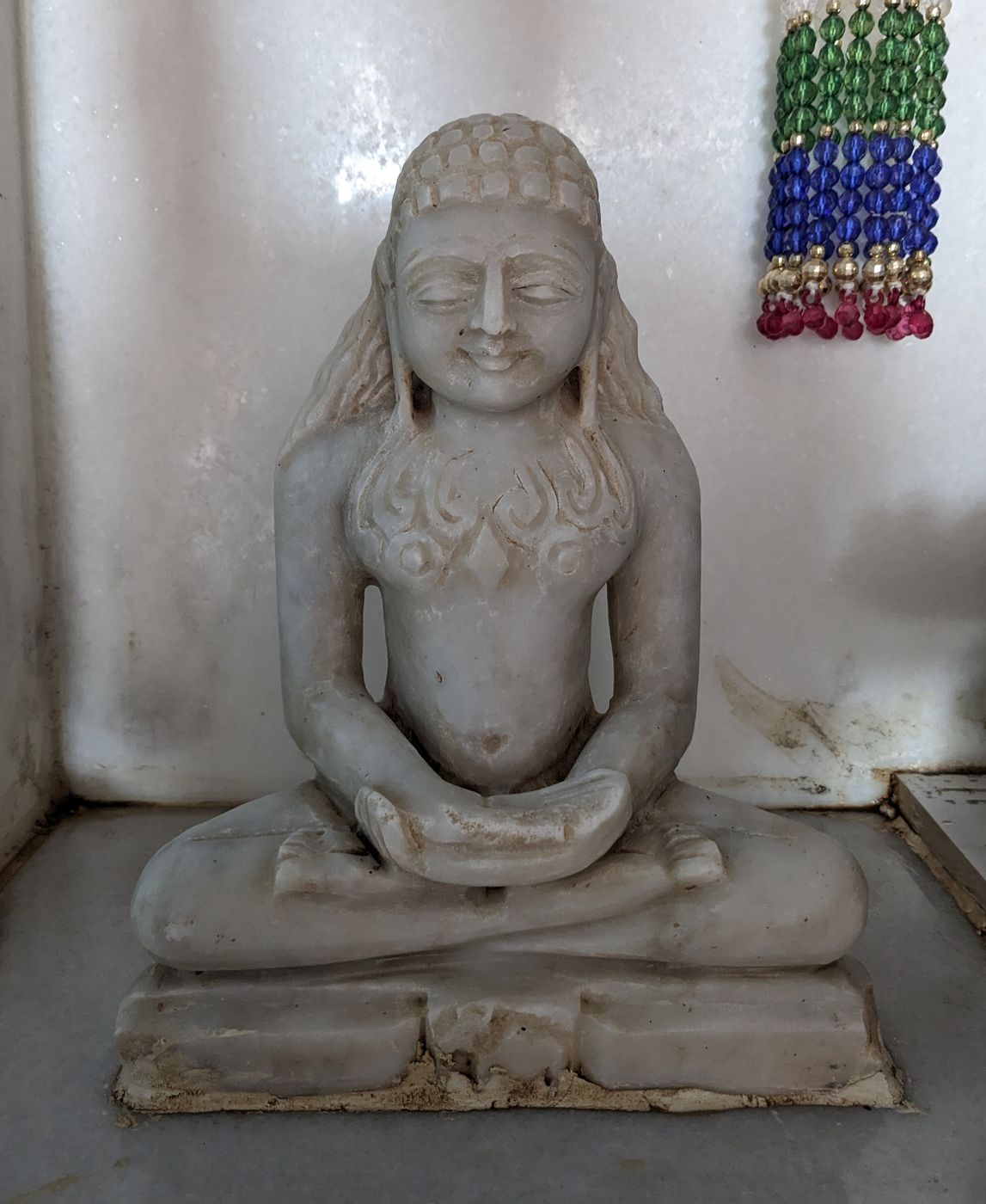
The Renunciation, and Why His Idols Have Hair
How the turn came is a genuine sect difference, and both versions are beautiful. In Hemachandra’s Shvetambara account, a spring festival stirs his clairvoyant memory of higher joys, and the Lokantika gods formally remind him: “establish the dharma-tirtha; remember your own task.” In the Digambara Adi Purana, Indra stages a dance by the apsara Nilanjana, who dies mid-performance; Indra instantly substitutes a double so seamlessly that no one notices, except Rishabha, who alone perceives the swap, and in that perception sees the whole world’s impermanence. A relief of Nilanjana’s dance was carved at Mathura around 100 BCE, which tells you how old this telling is.
He gave for a full year before leaving: Hemachandra records 388.8 crore gold pieces distributed. Then, under an ashoka tree, after a three-day fast, he pulled out his hair.
Why Adinatha alone has hair on his shoulders
A renouncing Tirthankara plucks out his hair in five fistfuls. Rishabha had removed four when Indra, moved by the beauty of the remaining locks, requested: "Let it remain so." He consented. This is why, alone among all 24 Tirthankaras whose idols are otherwise deliberately identical, Adinatha is recognized by the locks falling on his shoulders, "shining," says Hemachandra, "like emerald on his golden shoulders." Next time you stand before a murti, look at the shoulders first.
Four thousand kings took diksha alongside him, and could not endure it. Starving but ashamed to return home, they drifted to the riverbanks, ate roots and fruit, wore bark and matted hair, and became, in the Jain telling, the first ascetics of the other paths. Even the origin of other religions’ renunciants is, in this tradition, a story about people who loved Rishabha but could not match him. And his grandson Marichi, who joined and then invented his own softer discipline, would wander through lives upon lives and finally be reborn as Mahavira. The first Tirthankara’s family circle contains the last.
The 400-Day Fast and the Birth of Giving
Then came the problem no ascetic has faced since: alms-giving did not exist. No one had ever seen a monk beg. People offered the silent wanderer what they valued: horses, elephants, jewels, thrones, even their daughters. Never food. For roughly 400 days (thirteen months in the common telling) he fasted, “undepressed in mind,” because the failure was not theirs; generosity is a skill, and no one had taught it yet.
The teacher arrived through memory. At Hastinapur, prince Shreyansa, Rishabha’s own great-grandson, saw the monk and a past life broke open in him: he remembered serving as charioteer to the Chakravartin Vajranabha, Rishabha’s own previous birth, and in remembering, understood what a monk needs and how to give it. He offered fresh sugarcane juice, the crop of the Ikshvaku name itself, and the scriptures say the juice was contained in the Master’s hands, “but his joy was not contained in Shreyansa’s heart.”
This is where Akshaya Tritiya comes from
The date was Vaishakha Shukla 3. In Jain tradition, this first alms-giving is the origin of Akshaya Tritiya itself, and it is why, every year, thousands of Jains who have completed the thirteen-month alternate-day varshitap fast break it with sugarcane juice at Hastinapur and Palitana. When the rest of India buys gold that day, Jains drink cane juice, remembering the day generosity was learned.
One more origin story hides in these silent years: two princes, Nami and Vinami, who had missed the distribution of kingdoms, stood serving the meditating Rishabha and demanding their share. He could give nothing; he had renounced everything. The serpent king Dharanendra, honoring their devotion, granted them the 48,000 vidyas and the twin mountain rows of Vaitadhya, founding the Vidyadhara realms, the very clans that appear in the Jain Ramayana as the “monkeys” and “demons.” The epics’ cast descends from two boys who would not stop serving.
Omniscience and the First Sangha
After 1,000 years of austerity, on Phalguna Krishna 11 under a banyan tree at Purimatala (near Ayodhya in Hemachandra; Digambara tradition places it near Prayagraj and links the tree to the Akshayavata; we give both), kevala jnana arose. The gods built the first samavasarana, and the fourfold sangha was born, at a scale the texts record precisely:
Congregation of Rishabhanatha per the Kalpasutra and Hemachandra (Shvetambara). Note what the numbers say: women outnumbered men in his sangha, in both the ordained and lay communities.
Brahmi was ordained at the head of the nuns. Her sister Sundari was blocked from ordaining by Bharata, who wanted her as his consort-jewel; she answered with 60,000 years of ayambil austerity until Bharata, finally seeing her emaciated frame, understood that “she has in reality been initiated at heart” and relented. The first laywoman of the era won her diksha by outlasting an emperor.
Rishabha also did something that explains every Jain temple you have ever entered: he named the 23 Tirthankaras still to come, down to Mahavira. Hold that thought until his nirvana.
A Mother Who Beat Everyone to Moksha
Old, blind from weeping for her son, Marudevi rode an elephant to see him in his glory. Seeing it, understanding in one instant that her grief had been for someone who needed none of it, she ascended through the stages of purity while still seated on the elephant, and attained moksha in that moment, death and omniscience together. The first liberated soul of our entire era: not the Tirthankara, but his mother, a laywoman who never took a single vow. Hemachandra adds one line of devastating tenderness: from the gods’ handling of her body, “from that time, funeral rites existed among the people.” Even mourning is something the world learned from this family.
An honest sect difference, and a big one
Digambara doctrine holds that moksha is not possible from a woman's body, so in Digambara tradition the era's first liberated soul is instead one of Rishabha's sons, most commonly identified as Bahubali. The disagreement about Marudevi is, in miniature, the sects' whole debate about women's liberation. We present both positions and crown neither.
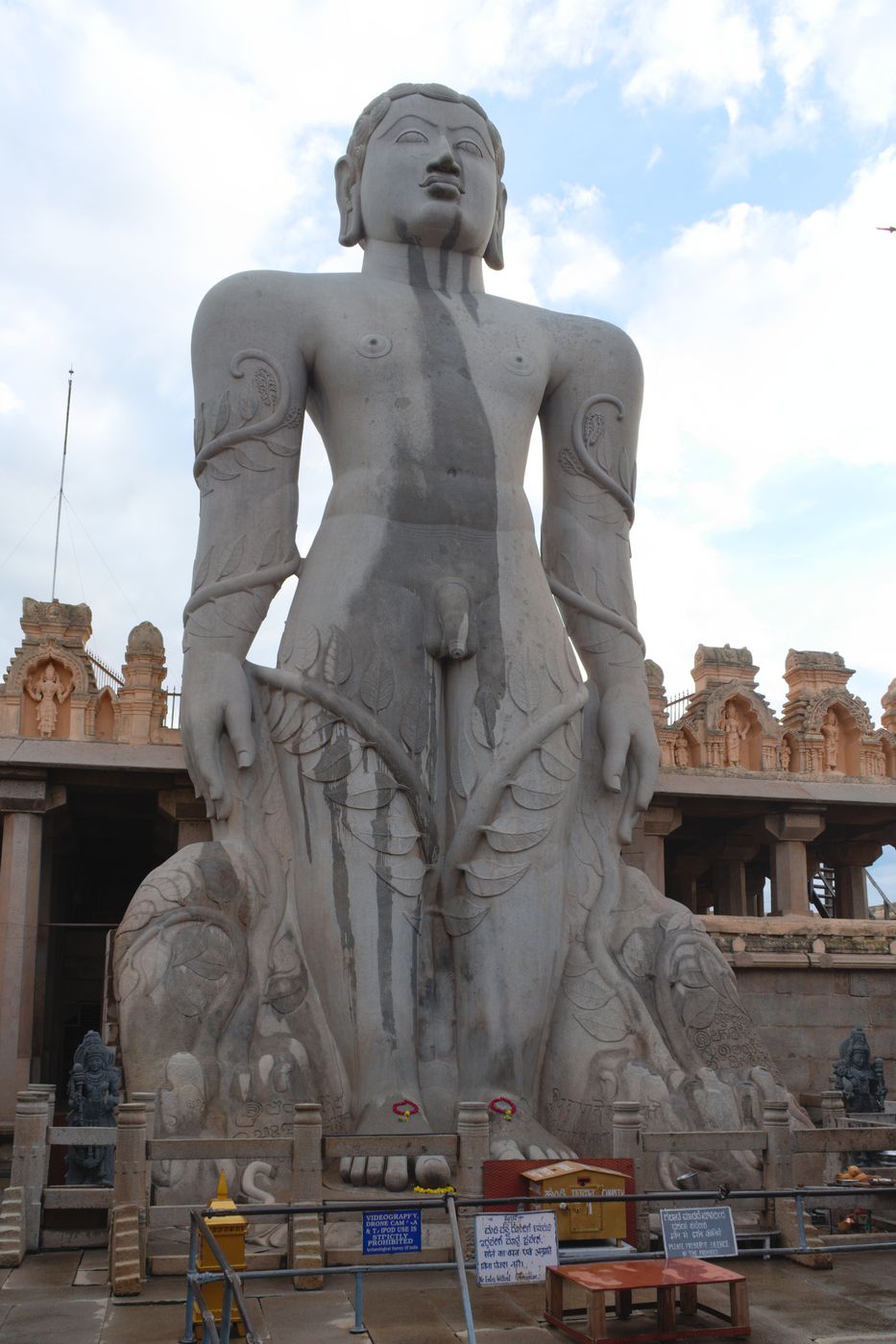
Bharata and Bahubali: The Fight That Built a 57-Foot Statue
Rishabha’s hundred sons inherited the world, and the eldest, Bharata, set out to rule all of it. Tradition holds that Bharatavarsha, India’s own name for itself, remembers him. Ninety-eight brothers, ordered to submit, went instead to their father, who told them the real enemies were “love, hate, delusion, the passions,” and all 98 renounced on the spot. Only Bahubali refused to bow.
Two armies met, and the gods intervened with a proposal that still reads like a rebuke to every war since: let the brothers fight in person and leave the world out of it.
| The duels | Shvetambara (Hemachandra) | Digambara / popular telling |
|---|---|---|
| Count | Five duels | Three contests |
| 1 | Eye-battle (staring): Bahubali wins | Drishti-yuddha (staring): Bahubali wins |
| 2 | Voice-battle: Bahubali wins | Jala-yuddha (water-splashing): Bahubali wins |
| 3 | Arm-battle: throws Bharata skyward, catches him as he falls | Malla-yuddha (wrestling): Bahubali wins |
| 4 | Fist-battle: fells Bharata | — |
| 5 | Staff-battle: driven to his neck into the ground, still wins | — |
| After | Bharata hurls the chakra; it refuses a kinsman | Same tradition of the chakra’s refusal |
Humiliated, Bharata hurled his chakra, the invincible discus of a world-emperor, and the tradition delivers one of its finest lines: the chakra cannot harm a kinsman. It circled Bahubali “like a pupil circling his guru” and returned. Bahubali raised his fist for the final blow, looked at it, and saw everything: “Shame on a brother’s murder, undertaken for a kingdom.” The raised fist rose higher, and he tore out his own hair with it. Renunciation on the battlefield, mid-strike.
But pride has a longer root than kingdoms. Too proud to enter the assembly where his 98 younger brothers now outranked him in monastic seniority, Bahubali stood in kayotsarga for a year, vines climbing his body, birds nesting on him, serpents at his ankles. In the Shvetambara telling his sisters Brahmi and Sundari were sent with one sentence: “Kevala cannot arise in one seated on an elephant.” He looked for the elephant and found it was his own pride. The moment he lifted his foot to go bow to his brothers, omniscience arose, at the first step. (In the Digambara telling it is Bharata’s arrival and veneration that breaks the deadlock; two versions, one lesson.)
Bharata’s own end answers his brother’s. Years later, in his hall of mirrors, a ring slipped from his finger, and the emperor of the world stared at one bare finger looking “like the moon by day.” He removed every ornament, watched his splendor vanish piece by piece, and attained kevala jnana standing in his own palace (so the Shvetambara account; Digambaras, holding that omniscience requires the monk’s state, have him take diksha first). The brother who won everything and the brother who renounced mid-punch arrived at the same place.
The Nirvana, and the First Temple of All 24
On Mount Ashtapada, with 10,000 munis, Rishabha took the final fast and passed into nirvana on Magh Krishna 13 (Shvetambara; the 14th in Digambara observance), in the constellation Abhijit. Jains observe it to this day as Meru Trayodashi. Indra performed the first cremation; from it, tradition says, came the human practice of funeral rites.
Then Bharata built something that explains a puzzle you have seen in every Jain temple: he raised on Ashtapada the Sinhanishadya shrine, housing jeweled images of all 24 Tirthankaras, gold, lapis, crystal, cat’s-eye, ruby, each with the correct color and stature. All 24, though 23 of them had not yet been born, because Rishabha had already named every future Tirthankara down to Mahavira. Every 24-image Jain temple on earth is, by tradition, a copy of a temple built when only one of the 24 had lived.
Bharata then cut the mountain into eight sheer terrace-steps (“ashta-pada,” eight steps) that no human could climb, guarded, the text says, by mechanical iron men, which is why the tradition holds this first of all tirthas to be inaccessible in our age. Tradition identifies the mountain with Kailash.
Where the World Still Meets Him
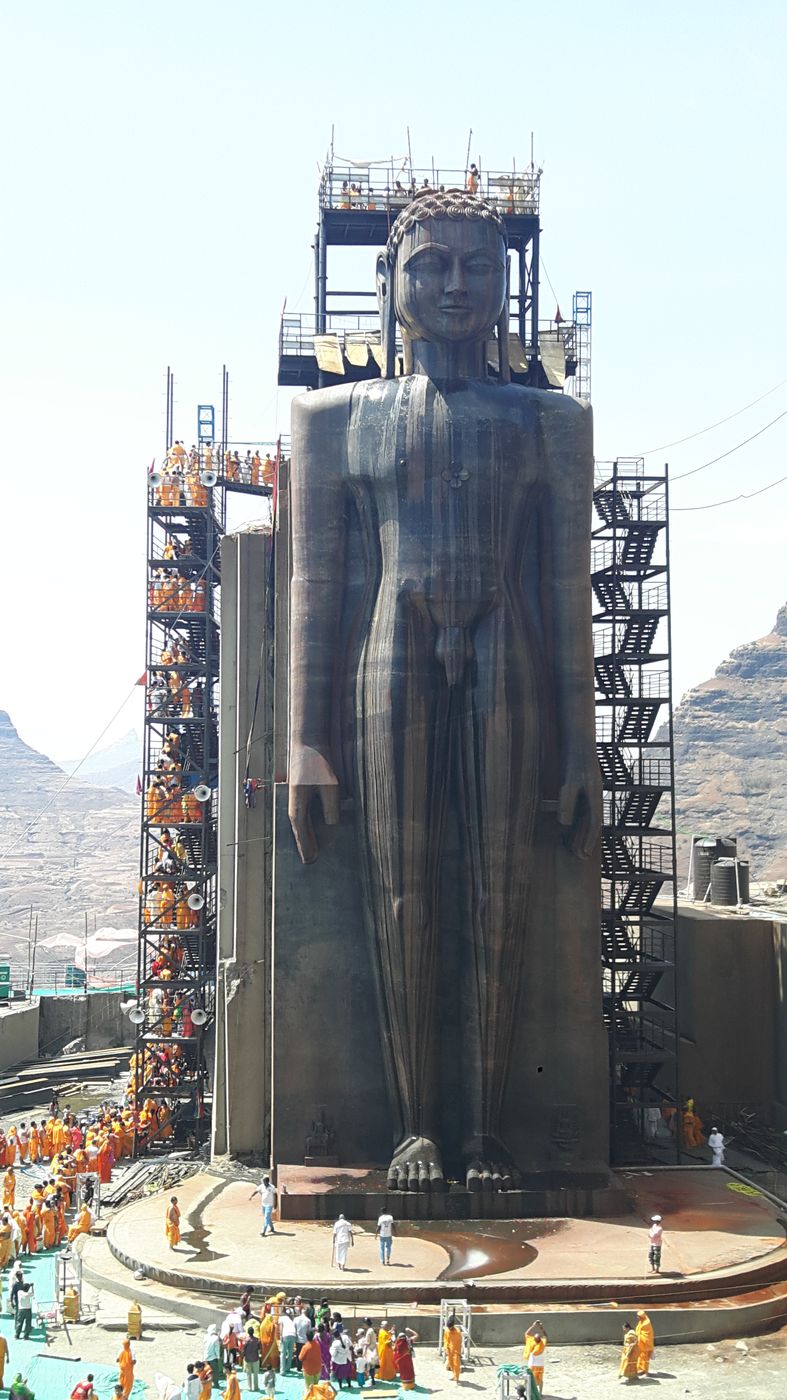
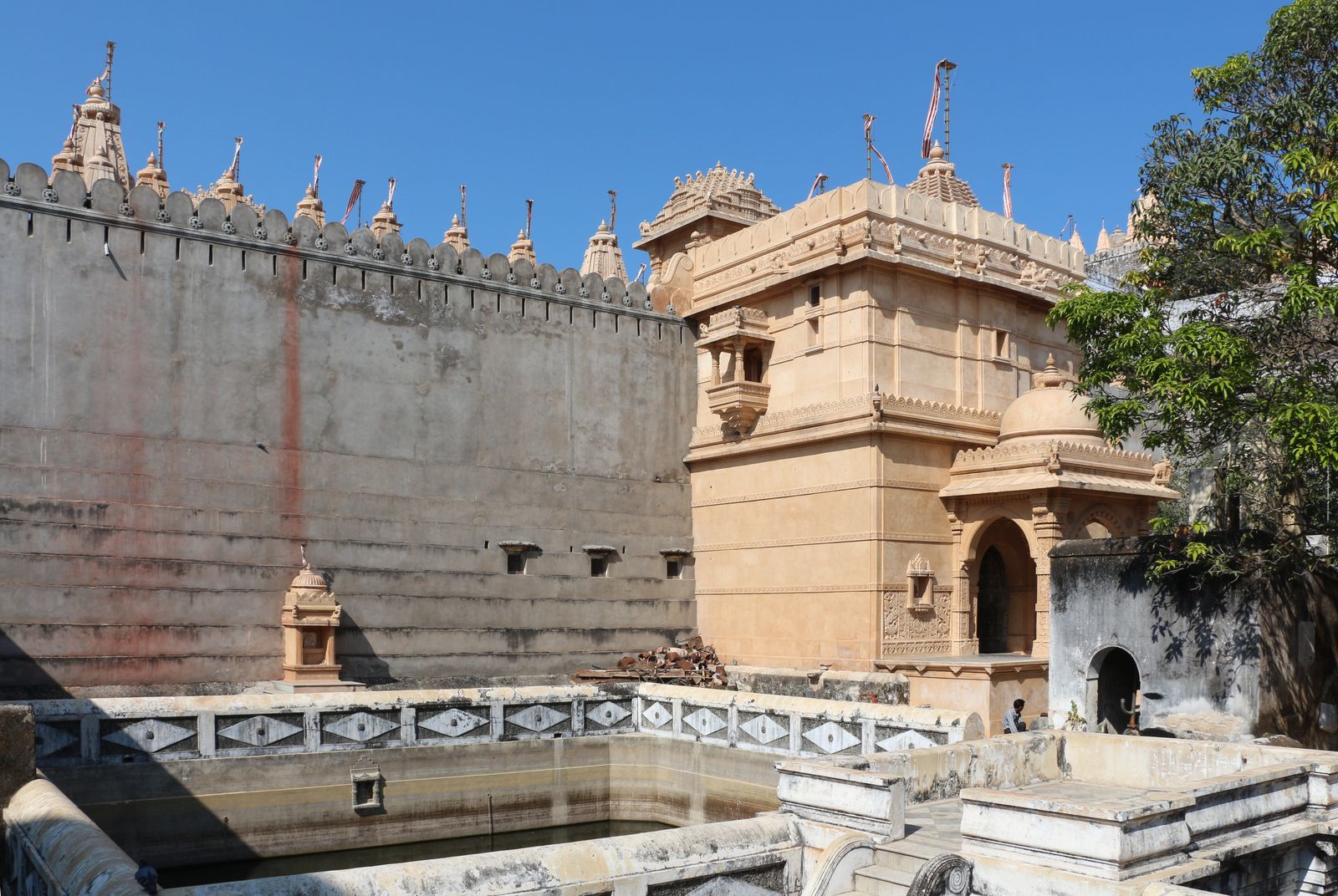
Humanity has never stopped carving him, and it has carved him bigger than anyone else in Jain history:
Monolithic colossi of Rishabhanatha (gold bars) and of his son Bahubali (muted bar). The Statue of Ahimsa holds the Guinness record (2016) as the world's tallest Jain idol.
| Where | What | Why it matters |
|---|---|---|
| Palitana (Gujarat) | “Dada Adishvara,” mulnayak of ~900 temples | Tradition says he ascended Shatrunjaya 99 times; the Navanu Yatra re-enacts it |
| Ranakpur (Rajasthan) | Four-faced Adinatha, 1439 CE | 1,444 carved pillars, no two alike |
| Dilwara, Mount Abu | Vimal Vasahi, 1031 CE | The oldest of the marble miracles is his |
| Kundalpur (MP) | “Bade Baba,” ~15 ft seated | Colonial surveyors misidentified him twice; tradition corrected the record |
| Kesariyaji (Rajasthan) | Black stone “Kala Baba,” temple dated 874 CE | Worshipped with saffron by Jains and venerated by the Bhil tribal community; the Supreme Court has ruled the shrine a Jain temple |
| Ayodhya (UP) | His birthplace in tradition; 31-ft standing idol today | Jain tradition counts five Tirthankaras born at Ayodhya |
| Kulpakji (Telangana) | “Manikyaswami,” the green-stone Adinatha | Ancient southern Shvetambara tirth; legend links its worship to Mandodari |
| Hastinapur (UP) | The Parana Hall | Where thousands break the varshitap with sugarcane juice each Akshaya Tritiya |
And the Bhaktamar Stotra, the most beloved hymn in Jainism, which we are studying verse by verse, is addressed entirely to him.
Where the Traditions Meet
The Bhagavata Purana (canto 5) reveres Rishabha as an avatar of Vishnu, and the overlap is startling: same father Nabhi, same mother (Merudevi), same 100 sons including Bharata, the same wandering renunciant’s end. The standard scholarly study (Padmanabh Jaini, 1977) reads this as the Vaishnava tradition absorbing an already-established Jain figure; Radhakrishnan wrote that the Bhagavata “endorses the view that Rishabha was the founder of Jainism.” We state the direction as the scholarly majority view, not as fact, and we honor the astonishing thing itself: the first Tirthankara is revered inside the Hindu canon.
Three cautions we publish so you never have to unlearn them: claims that the Rigveda names him rest on a common noun meaning “bull” (the stronger, still-contested citation is from the Yajurveda); readings of Indus Valley bull seals and standing figures as “proto-Rishabha” are speculation without mainstream acceptance; and the “Adinath” of the Nath yogi lineage is Shiva, a different figure who shares only the honorific “First Lord.”
The Sect Differences at a Glance
| Question | Shvetambara | Digambara |
|---|---|---|
| Previous births | 13 (Hemachandra’s sequence) | 10 (Adi Purana) |
| Mother’s dreams | 14, white bull first | 16, Airavata elephant first; Nabhi interprets |
| Birth date | Chaitra Krishna 8 | Chaitra Krishna 9 |
| Wives | Sumangala and Sunanda | Yashasvati and Sunanda |
| Renunciation trigger | Spring festival + Lokantika gods | Nilanjana’s dance and death |
| The brothers’ duels | Five (eye, voice, arm, fist, staff) | Three (sight, water, wrestling) |
| What freed Bahubali | His sisters’ words about the elephant of pride | Bharata’s coming and veneration |
| First moksha of the era | Marudevi, on the elephant | A son of Rishabha (women’s moksha not accepted) |
| Bharata’s kevala | In the palace, at the mirror | After taking diksha |
| Nirvana date | Magh Krishna 13 (Meru Trayodashi) | Magh Krishna 14 |
Both tellings are old, internally consistent, and honored here. Where they differ, neither is wrong.
What His Life Teaches Now
- Build first, renounce later. He completed his duty to the world, then let it go. Contribution before detachment, not instead of it.
- Teach your daughters. Writing to Brahmi, mathematics to Sundari, at the dawn of time, one from each hand.
- Generosity is a skill someone must teach. Four hundred days of fasting happened not from cruelty but from ignorance. Giving properly is culture, and culture is taught.
- Pride survives renunciation. Bahubali gave up a kingdom in mid-punch and then stood a full year defeated by seniority. The last attachment to fall is the one that feels like dignity.
- The chakra will not cut kin. Even the emperor’s ultimate weapon refused a brother. Keep that image for every family dispute you will ever have.
- No one is beyond the arc. A caravan merchant’s cup of ghee became, thirteen lives later, the man who taught the world everything.
His Birth Star, and Yours
Rishabha’s entire life runs on one star: conception, birth and diksha all came with the moon in Uttarashadha (his kevala arose under Abhijit, which sits within Uttarashadha’s span). Uttarashadha, ruled by the Sun, is the nakshatra of the “later victory,” the win earned by patience rather than speed; its symbol is the elephant’s tusk. For the man who waited an age to renounce, fasted 400 days for want of a giver, and practiced a thousand years before omniscience, the tradition could not have recorded a more fitting star.
Find your own janma nakshatra with the free kundali tool; if it is Uttarashadha, the tradition invites devotional kinship with Adinatha: his kalyanaka days, his hymn, his story. Kinship, not destiny. The traditional Jina mantra is Om Hreem Shri Rishabhadevaya Namah. Practices, never purchases.
Sources: Hemachandra's Trishashti-Shalaka-Purusha-Charitra, Book I (Johnson translation, 1931, via wisdomlib.org), read chapter by chapter for this page; the Kalpasutra's Life of Rishabha (Jacobi translation); Jinasena's Adi Purana per standard references for the Digambara telling; Jainpedia on Marudevi and Bahubali; Wikipedia's sourced articles on Rishabhanatha, the Statue of Ahimsa, Bawangaja, Kesariyaji, the Palitana temples and the Bhagavata Purana's Rishabha; Pew and temple-trust sources as linked from our mission page. Scriptural time-spans are presented as scripture's own frame. Where the sects differ, both tellings are given. Corrections are seva: tell us.